

Yes. Public pricing, product pages, and interactive demos are available before you speak to us. AI Architect can recommend a route and price band. A call is optional when you want to discuss fit, not a gate placed in front of basic information.
Verity
The engine underneath QAShift. Playwright, axe-core, ZAP, Semgrep.
Useful when replacing: a pile of half-configured testing tools
Managed cloudFree tierPublished plan limitsManaged hosting
Pricing · USD
Plans
From $49/mo
A hosted product with a free tier. Start on it, stay on it, or leave — no contract.
Free tier
Free tier · no card
Start free, no card. Upgrade when the limits bite, not before.
Start free: cloud sandbox, 15 AI-generated UI tests a month, unlimited CI runs once your pipeline is configured. Pro is $49/mo — 200 UI + API tests, self-healing locators, flake detection, 3 projects. Team is $149/mo — 750 tests, 10 projects, priority support. Want an engineer verifying every test? That's managed QAShift, from $499/mo. CI runs are unlimited on every tier; the AI test generation is what's metered, because that's what costs us money to run.
verity.qashifthq.com
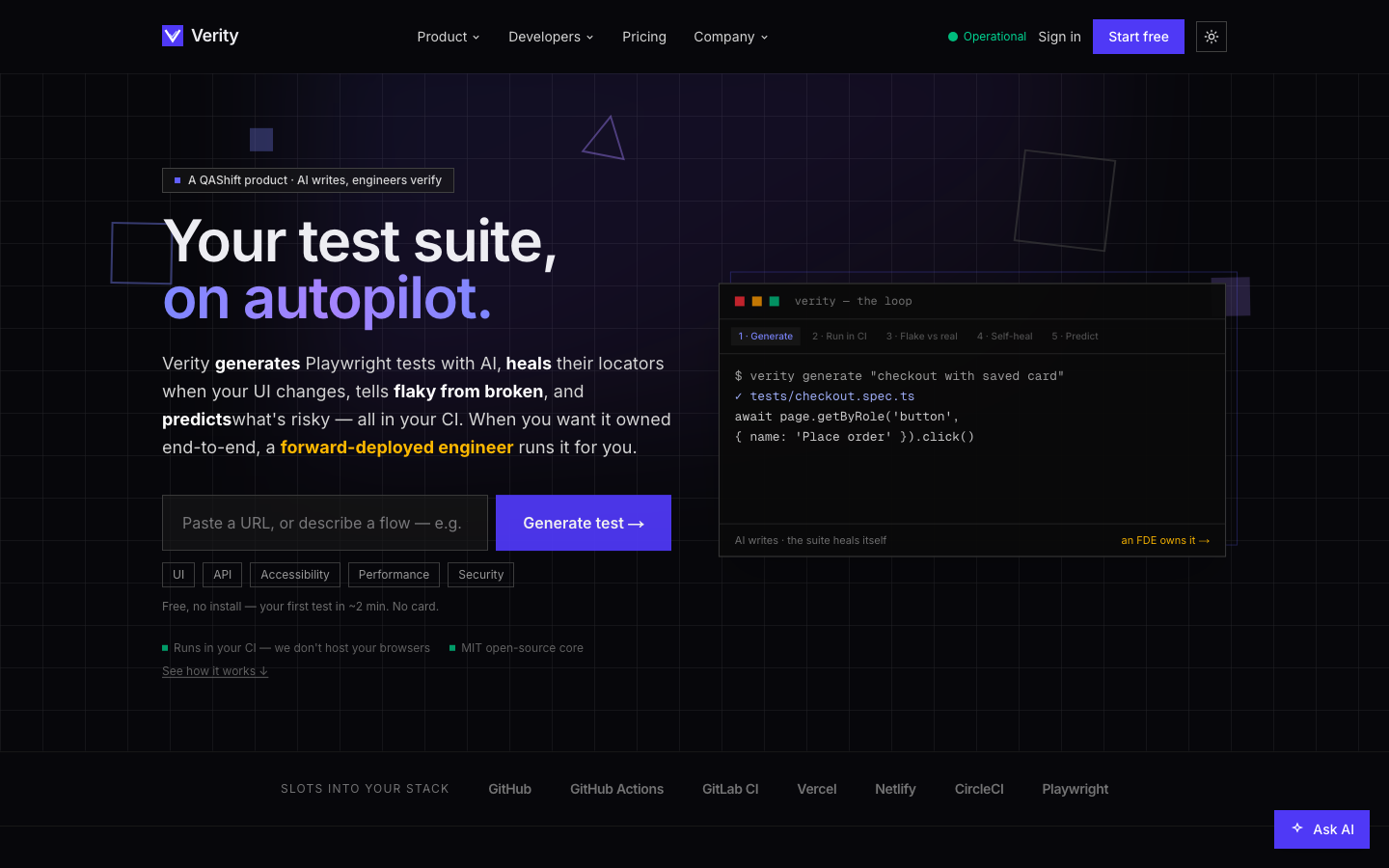
The problem
Playwright, axe-core, ZAP, and Semgrep are all excellent — and all separate. Wiring them into one pipeline, keeping them updated, and making their output readable is a full-time job nobody was hired for.
How Verity solves it
One engine, four disciplines
Functional, accessibility, security, and static analysis run as a single orchestrated suite with one unified report.
Runs in your infrastructure
Self-hosted, MIT licensed. Your code and test artifacts never leave your network.
CI-native
Drops into GitHub Actions, GitLab CI, or Jenkins as a single step. Fails the build with reasons, not noise.
Delivery terms — stated precisely
How Verity is delivered, what you control, and where the boundaries sit.
Managed cloud
Hosting and data terms are stated on the product plan.
Data and hosting
This is a managed product. Plan limits, data processing terms, retention, and any self-host option are stated for that product — not implied by a company-wide promise.
Compliance boundary
Residency, controls, and regulatory requirements are implementation decisions documented in the selected plan or delivery scope.
Built on
Playwrightaxe-coreOWASP ZAPSemgrepDocker
More to build your product
Verity — the questions buyers ask
Own Verity, don't rent it.
See the price, deploy on your infrastructure, keep the code. Or scope a sprint and we'll customise it and hand it over.